

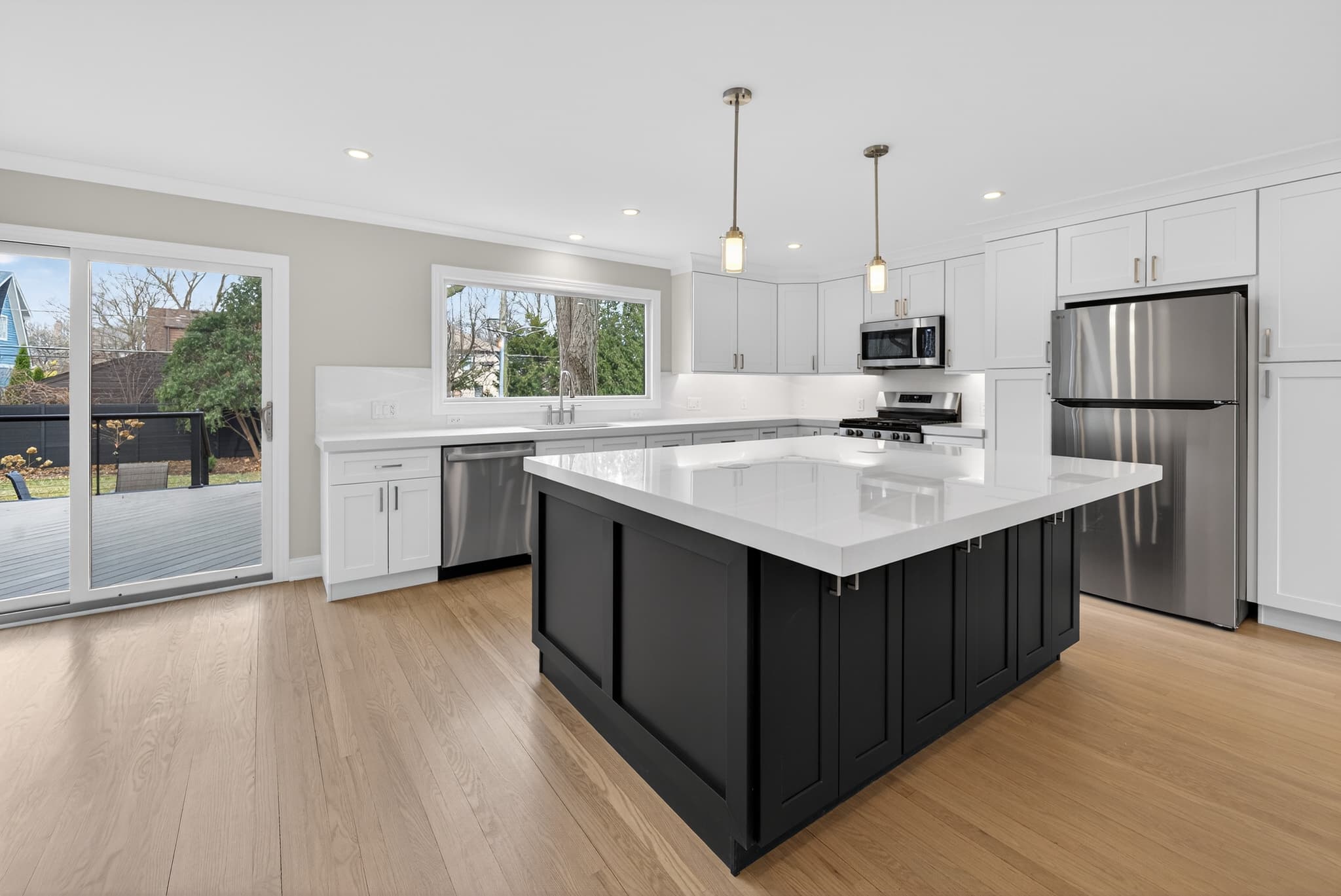
Cabinets are the single largest investment in a kitchen remodel — typically 30 to 40% of the total project cost. They also define the visual style of the kitchen more than any other element. Countertops, backsplash, and hardware all matter, but cabinets set the tone.
The door style is the first and most visible choice. Here's what's available and what works best in different types of Chicagoland homes.
Shaker
The Shaker door is the most popular cabinet style in America, and it's been the dominant choice in Chicagoland kitchens for over a decade. It's a five-piece door with a flat center panel and a clean, rectangular frame — simple, versatile, and hard to get wrong.
Why it dominates: Shaker works in almost every context. It reads as traditional in a classic white kitchen with crown molding. It reads as transitional with matte hardware and quartz countertops. And in a dark color with minimal hardware, it can even lean contemporary. No other door style has that range.
Best in: Almost any Chicagoland home. Shaker is the safe choice — not because it's boring, but because it's genuinely versatile. If you're unsure about style, start here.
Cost: Shaker is available at every price point, from $80/linear foot in stock to $400+/linear foot in custom. This is the door style with the most options across the quality spectrum.
Flat Panel (Slab)
A flat panel door is exactly what it sounds like — a single flat surface with no frame, no raised panel, no detail. Completely smooth. Handles or pulls are the only visual element.
Why people choose it: Flat panel is the contemporary, minimalist choice. It creates clean lines and unbroken surfaces that let other elements (countertops, backsplash, lighting) take visual priority. In a high-end modern kitchen, flat panel with integrated handles (a routed groove along the top edge instead of hardware) is the gold standard.
Watch out for: Flat panel shows fingerprints and surface imperfections more than any other door style. In a matte finish this is manageable. In a high-gloss finish — which looks incredible when clean — every smudge is visible. Families with young children may find this frustrating.
Best in: New construction and modern renovations in Elmhurst, Oak Brook, and the western suburbs. Less common in older traditional homes where it can feel out of context.
Cost: Flat panel is typically less expensive than Shaker at the same quality tier because the door construction is simpler. Stock flat panel runs $70 to $120/linear foot.
Raised Panel
Raised panel is the traditional choice — a door with a center panel that is raised (slightly elevated) relative to the surrounding frame. The effect is more ornate than Shaker and reads as formal and traditional.
Why people choose it: Raised panel is the right choice when the kitchen needs to match a traditional home's existing architectural character — crown molding, wainscoting, formal dining room. In a colonial, Georgian, or traditional craftsman home, raised panel feels intentional. Shaker in the same context can feel like a renovation that didn't commit to the home's style.
Watch out for: Raised panel is harder to clean than flat or Shaker — the grooves and transitions collect grease and dust. It also looks dated if the rest of the home has been modernized. The trend in Chicagoland has moved decisively away from raised panel in the last 5 years.
Best in: Traditional homes in Barrington, Lake Forest, and Hinsdale where the homeowner wants to preserve the home's original character. Not recommended for contemporary renovations.
Cost: Raised panel is typically 10 to 20% more expensive than Shaker at the same quality tier because the door construction is more complex.
Free Kitchen & Bathroom Remodel Estimate
Culture Construction is a veteran-owned, licensed Illinois general contractor serving Elmhurst and the greater Chicagoland area. Design-build kitchen and bathroom remodeling with a 10-year workmanship warranty.
Beadboard
Beadboard doors have vertical grooves (beads) across the center panel, creating a cottage or farmhouse look. It's a niche choice but a persistent one — beadboard never quite goes out of style in certain home styles.
Why people choose it: It's the farmhouse kitchen door. For homeowners going all-in on a farmhouse aesthetic — apron-front sink, open shelving, shiplap — beadboard cabinets complete the look. It's also a good choice for a mudroom, laundry room, or butler's pantry in a home that has a different primary kitchen style.
Best in: Farmhouse-style homes and casual kitchen designs. Works particularly well in kitchens that open to a family room with a relaxed, lived-in aesthetic.
Inset
Inset cabinets are the premium tier. Instead of the door sitting on top of the cabinet face frame (overlay construction, which is standard for all the styles above), the door sits flush inside the frame. The result is a perfectly flat front surface with visible frame lines around each door — clean, precise, and unmistakably high-end.
Why people choose it: Inset cabinets signal quality. The fit has to be near-perfect — every door aligned, every gap consistent — which requires significantly more labor and precision than overlay cabinets. Interior designers and architects specify inset for high-end projects.
Watch out for: Cost. Inset cabinets are 30 to 50% more expensive than the same door in overlay construction, because the manufacturing tolerances are tighter and the installation is more labor-intensive. Also, inset doors are more sensitive to humidity-driven wood expansion — in a Chicagoland home with seasonal humidity swings, the doors may bind slightly in summer.
Best in: Premium kitchens in Hinsdale, Winnetka, Burr Ridge, and Oak Brook. Not worth the upcharge in a mid-range remodel where the budget is better spent elsewhere.
Cost: Custom only. $400 to $1,000+/linear foot depending on wood species and finish.
Making the Choice
The door style should match the home's architectural character, the homeowner's aesthetic preference, and the project budget. In our experience at Culture Construction, about 60% of Chicagoland homeowners choose Shaker, 25% choose flat panel, and the remaining 15% split among raised panel, beadboard, and inset.
If you're not sure, visit a cabinet showroom with full-size displays rather than looking at small door samples. The scale of a full kitchen wall of cabinets reads very differently than a 4x4 inch sample.
We help homeowners select cabinets as part of our design-build process — visiting showrooms together, comparing options within your budget range, and making sure the door style works with the countertop, backsplash, and hardware you've chosen.