

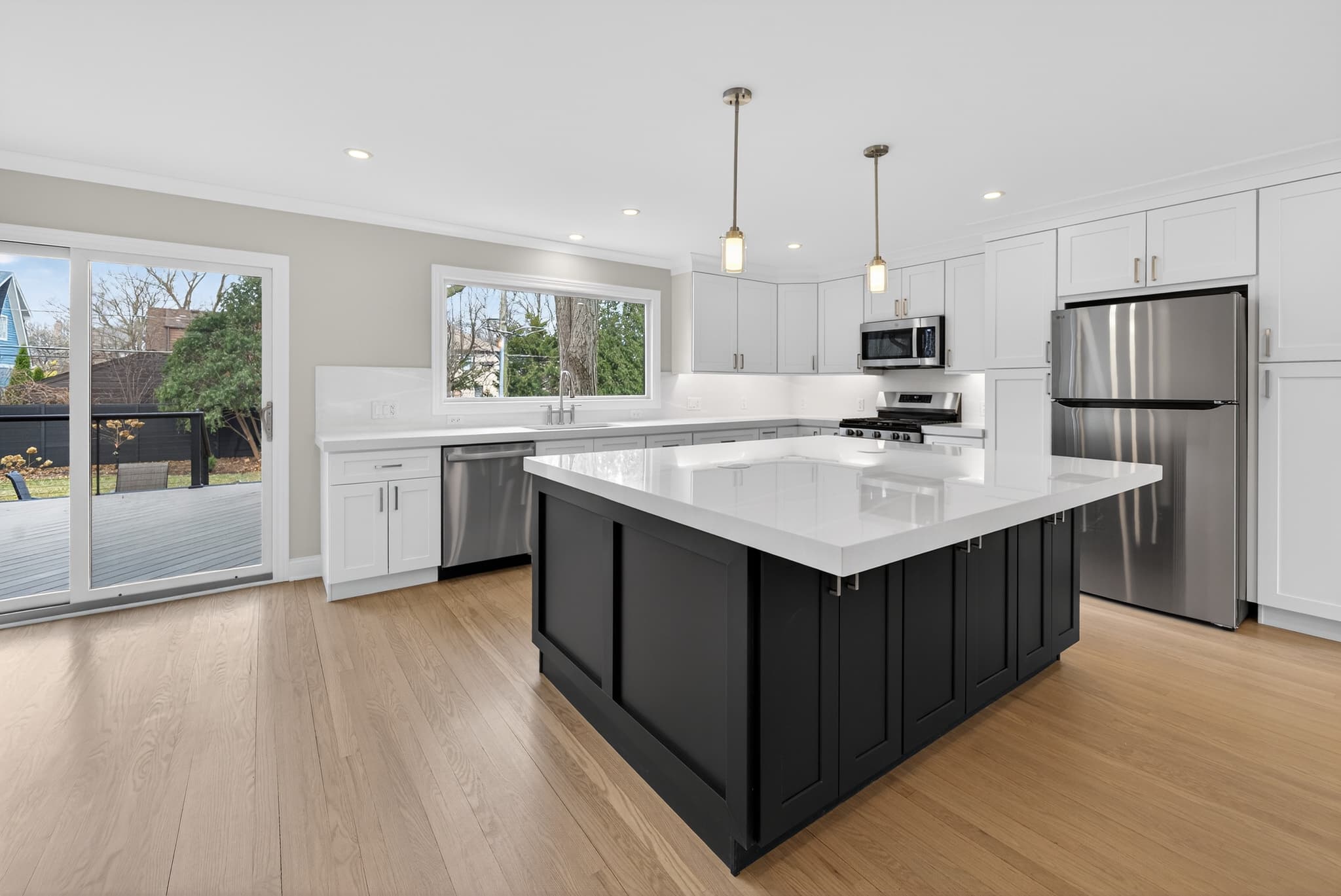
Ten years ago, granite was the default premium countertop for any serious kitchen remodel in the Chicago suburbs. Today, quartz has taken that position — and it's not close. In our projects at Culture Construction, roughly 70% of homeowners choose quartz, 20% choose granite, and the remaining 10% go with butcher block, marble, or solid surface.
But the shift toward quartz doesn't mean granite is a bad choice. They solve different problems, and the right answer depends on what matters most to you.
What They Actually Are
Granite is a natural stone. It's quarried in large blocks, sliced into slabs, polished, and fabricated to fit your kitchen. Every slab is unique — the veining, color variation, and mineral patterns are one of a kind.
Quartz is engineered stone. It's roughly 90 to 95% ground natural quartz crystals mixed with 5 to 10% polymer resins and pigments, then formed into slabs under heat and pressure. The result looks and feels like natural stone but with controlled, consistent patterns.
The Comparison
Cost
Granite: $50 to $150 per square foot installed, depending on the stone. Common granites (Luna Pearl, Giallo Ornamental, Uba Tuba) are on the lower end. Exotic granites (Blue Bahia, Van Gogh, Patagonia) push toward the high end.
Quartz: $60 to $120 per square foot installed. Mainstream brands (Cambria, Caesarstone, Silestone, MSI) cover most of this range. Ultra-premium lines with complex veining patterns (Cambria Brittanicca, Caesarstone Empira) are at the top.
The midpoints are similar — for a typical 40 to 50 square foot kitchen, the material difference between a mid-range granite and a mid-range quartz is usually $500 to $1,500 total.
Maintenance
This is where quartz wins decisively.
Granite is porous and requires sealing once a year (sometimes more for lighter colors). If the seal wears through, the stone can absorb liquids — wine, oil, coffee — and stain permanently. Acidic substances like lemon juice can etch the surface.
Quartz is non-porous. It never needs sealing. Spills wipe up without absorbing. It doesn't stain from wine, coffee, or acidic foods. For a busy family kitchen in Elmhurst or Naperville where spills are a daily occurrence, this is the deciding factor for most homeowners.
Appearance
Granite offers something quartz cannot: genuine uniqueness. Every granite slab has natural variation — no two kitchens will have exactly the same countertop. If you value the organic character of natural stone and are willing to select your specific slab at the stone yard, granite delivers that.
Quartz offers consistency. If you want the same veining pattern across your entire kitchen — island, perimeter, bar — quartz guarantees it. Quartz also excels at mimicking marble's look (Calacatta, Carrara patterns) without marble's softness and maintenance demands.
Both are available in hundreds of colors and patterns. Neither looks cheap when well-chosen.
Durability
Both are extremely hard and resist scratches from normal kitchen use. Granite is harder (7 on the Mohs scale vs. 6 to 7 for quartz), but in practice both shrug off knives, pots, and everyday wear.
The one durability advantage granite holds: heat resistance. You can set a hot pan directly on granite without damage. Quartz resins can discolor or crack at temperatures above 300°F, so trivets are recommended.
Environmental Considerations
Granite requires quarrying, which has environmental impact. Quartz manufacturing is energy-intensive. Neither is clearly superior on sustainability — the environmental choice is usually to keep your existing countertops and reface the cabinets, which isn't what anyone asks us about.
Which to Choose
Choose quartz if you want zero maintenance, consistent appearance, and the broadest selection of patterns — especially if you want a marble look without the marble hassle.
Choose granite if you value natural uniqueness, want to select your own slab, and don't mind annual sealing. Granite is also the better choice if you frequently set hot pans directly on the counter.
Either way, invest in quality fabrication and installation. A poorly templated countertop with visible seams and uneven edges will look cheap regardless of the material.
At Culture Construction, we work with trusted fabricators throughout the Chicagoland area and help homeowners visit stone yards to select their slabs in person. The countertop is the most visible surface in your kitchen — it's worth choosing it carefully.